Where to Stay
Where to Stay in Busan: The Beach or the Interchange
Updated · Fact-checked · By AsiaPicks Editorial Team
We may earn a commission if you book through links on this page, at no extra cost to you. How we make money
Our pick
Our pick for a first visit is Seomyeon if you are here for the city and Haeundae if you are here for the coast. Busan is linear, so unlike Seoul the choice changes your fare as well as your journey: crossing more than 10km puts every ride into the second fare section.
Why the choice works differently here
Seoul spreads out from a centre. Busan runs along a coast, over hills, for a long way. Two districts that look adjacent on a map can be half an hour apart, and the city has no single middle that everything is near.
There is a second consequence, and most guides miss it. Busan's subway charges by section: 1,600 won for the first 10km and 1,800 won beyond it, according to Busan Transportation Corporation. In a linear city, a base at one end pushes a lot of ordinary daily journeys over that boundary. The area you pick changes your fare here, which is not true in Seoul.
So the question is not just where you want to wake up. It is which end of the line you want to spend the week travelling from.
Seomyeon: the interchange
Seomyeon is where the subway lines cross and where the city's own life is concentrated: shopping, restaurants, bars, and residents rather than visitors. Most of Busan is one ride away rather than one ride and a change.
What it does not have is the coast. You will travel to the beach rather than walk to it. Our pick for a first visit weighted toward the city, for short stays, and for anyone who dislikes the feeling of commuting into a place they are visiting.
Hotel · Trip.com
Hotels in Seomyeon
Seomyeon listings on Trip.com, the central interchange district rather than the beach.
Check availability on Trip.comHaeundae: the beach
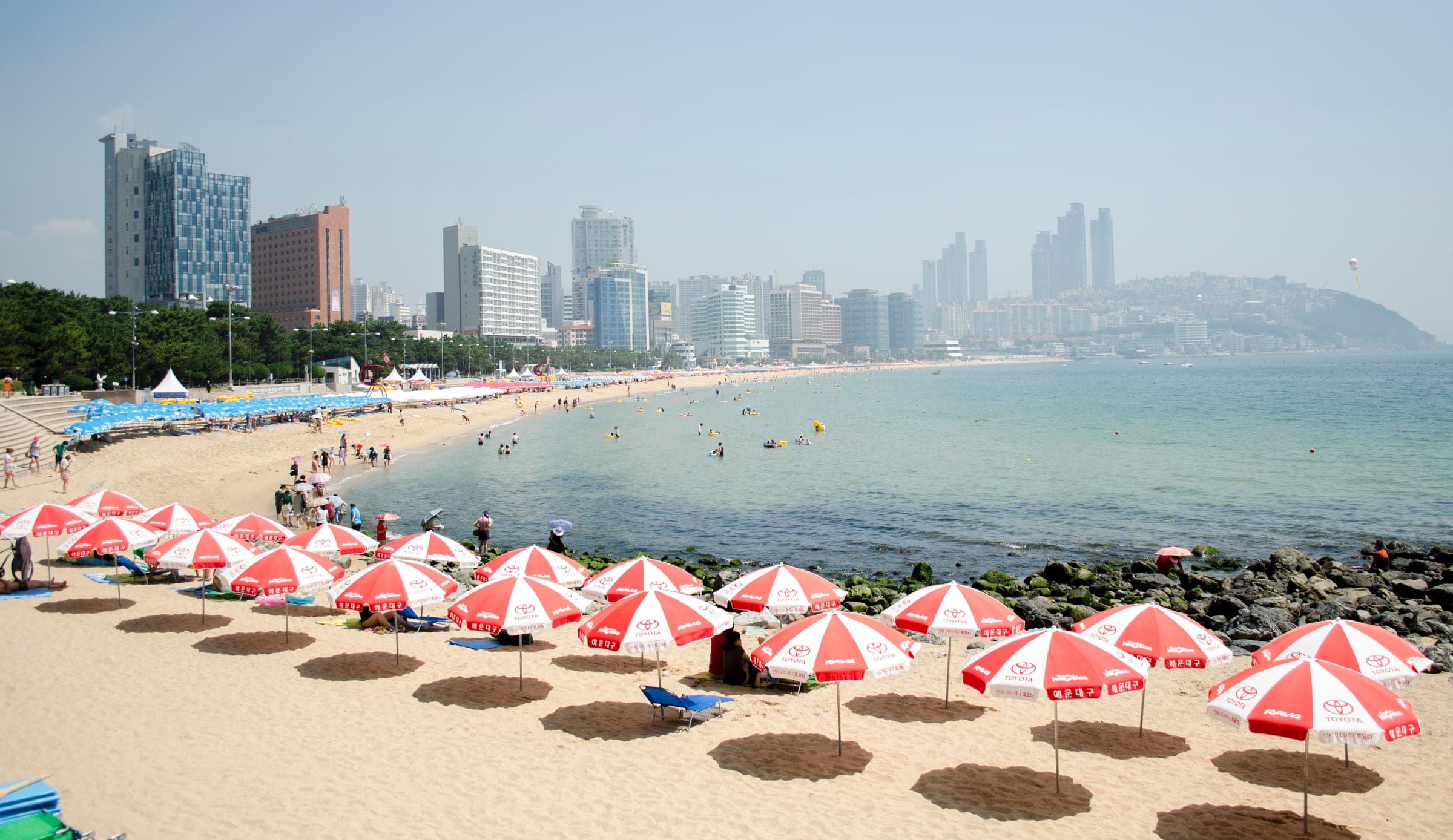
Haeundae is the resort end: sand, towers, aquarium, seafood, and a promenade that justifies itself on a summer evening. If the coast is your reason for coming to Busan, staying anywhere else is a daily argument with yourself.
The cost is distance from everything else, and the fare section that comes with it. Our pick when the beach is the trip rather than a feature of it, and for stays of three nights or more where the travel time amortises.
Gwangalli: the compromise
A beach, the bridge lit at night, closer to the centre than Haeundae and generally cheaper. It gives up Haeundae's resort density and gains position.
Our pick for travellers who want a beach without organising the whole trip around one, and the area we would suggest first to anyone undecided between the other two.
Nampo-dong and Busan Station: the old end
The old downtown, Jagalchi market, and the KTX terminus. Arriving from Seoul deposits you here, which misleads people into thinking it is central. It is one end of a long city.
Our pick only for one-night stops and for travellers whose interest is the market and the port rather than the coast.
How to decide
Answer one question: is this a beach trip or a city trip? Beach means Haeundae, or Gwangalli if you want the beach and the city both. City means Seomyeon. One night between trains means Busan Station.
The Busan travel guide covers fares, the airport and what the city is for.
Booking options
Hotel · Trip.com
Busan hotels
Trip.com's Busan listings, filterable by area, for comparing the coast against the centre on your dates.
Check availability on Trip.comFrequently asked questions
Is it better to stay in Haeundae or Seomyeon?
Haeundae if the beach is the reason you came, Seomyeon if the city is. Haeundae is a resort district with the sand on your doorstep and a long ride to everything else. Seomyeon is the central interchange, so most of Busan is one ride away, and the beach is not.
Does the area change what the subway costs in Busan?
Yes, which is unusual. Busan charges 1,600 won for one section, meaning the first 10km, and 1,800 won beyond that, per Busan Transportation Corporation. In a city strung along a coast, a base at one end puts a lot of daily journeys into the second section.
Where should you stay for the KTX from Seoul?
Anywhere on the subway, but Busan Station itself suits short stays. Arriving by KTX puts you in the old downtown end of the city rather than near the beaches, which is worth knowing when you book a hotel you assumed was central.
Is Gwangalli a good alternative to Haeundae?
It is the compromise. Gwangalli has a beach and the bridge view, sits closer to the centre than Haeundae does, and is generally cheaper. It trades Haeundae's resort infrastructure for being nearer everything else.
Sources
- Urban rail fare guide (Busan Transportation Corporation), checked Sep 12, 2026
Image credits
- Haeundae Beach: StephNurnberg (CC BY 2.0)
Related guides
How to Pay in Korea: Cards, Cash and Transit
Foreign cards work in most Korean shops. They fail at market stalls, on Korean websites and at the subway gate, and each of those gaps has its own workaround.
Updated Sep 13, 2026
Seoul Subway Fares and Transfers: What a Ride Actually Costs
What a Seoul subway ride costs on a transit card, why so many guides still quote an old fare, and the transfer rule that decides what you actually pay in a day.
Updated Sep 13, 2026
K-ETA or e-Arrival Card: Which One Do You Actually Need?
Most visitors to South Korea are exempt from the K-ETA, and that exemption is exactly what makes the e-Arrival Card mandatory for them instead.
Updated Sep 12, 2026
DMZ Tours from Seoul: What You Can Actually Visit
The DMZ can only be visited on a guided tour, and the JSA at Panmunjom has been shut to the public since December 2023. What that means for what you book.
Updated Sep 12, 2026