Planning
K-ETA or e-Arrival Card: Which One Do You Actually Need?
Updated · Fact-checked · By AsiaPicks Editorial Team
Short answer
You need exactly one of them, and most visitors need the e-Arrival Card. Being exempt from the K-ETA does not remove the paperwork; it moves it. The e-Arrival Card is free and is filed in the three days before you land.
Which form do you need?
One of the two, and for most visitors it is the e-Arrival Card. The rule is simpler than the coverage suggests: if you are going through the K-ETA process you file that and nothing else, and if you are not, you file the e-Arrival Card instead.
Because nationals of eligible visa-free countries are currently exempt from the K-ETA, most visitors fall into the second group. Exemption moves the paperwork rather than removing it.
Why does "no K-ETA needed" mislead people?
Because it is reported as good news about paperwork, and it is actually news about which paperwork. The K-ETA exemption for eligible visa-free nationals runs until 31 December 2026. Read quickly, that sounds like nothing to do before flying. It is the opposite: not holding a K-ETA is the precise condition that makes the e-Arrival Card mandatory for you.
KPMG's Global Mobility briefing of 30 January 2026 puts it plainly. The e-Arrival Card is required for any foreign traveller not subject to the K-ETA application process, and travellers who are exempt may apply for a K-ETA voluntarily to gain benefits including exemption from submitting an e-Arrival Card.
So the two forms are alternatives. What you cannot do is treat the exemption as covering both.
What happened to the paper arrival card?
It is gone. South Korea withdrew the paper arrival card on 1 January 2026 and replaced it with the digital e-Arrival Card. Any guide describing a card handed out by cabin crew on approach, or a desk to fill one in after landing, is describing a system that no longer runs.
This is the single most common way current advice about Korean entry is wrong, and it is worth using as a freshness test. A page that still explains how to complete the paper card has not been checked since 2025.
When is the e-Arrival Card due?
In the three days before you arrive. The card is submitted ahead of landing rather than after it, and it is free.
The practical reading is that this belongs with the last checks before a flight rather than with the things booked months ahead. The window opens three days out, so it cannot be completed early the way a K-ETA can, and it cannot be left for the airport either: the desk that used to hand out paper cards is gone.
Should you apply for a K-ETA anyway?
There is one concrete reason to: it exempts you from the e-Arrival Card. If you would rather complete one authorisation well in advance than a form in the days before departure, applying voluntarily achieves that.
Our pick for most short trips is the simpler path of filing the e-Arrival Card, because it is free and quick and the exemption already saves you the K-ETA. Anyone travelling repeatedly, or who dislikes having a deadline in the week of the flight, has the better case for applying.
What to check before you book
Two things change, and both have changed recently. The list of countries eligible for the exemption is published on the official K-ETA site and is the only authority on whether it covers you. And the exemption has an explicit end date, 31 December 2026, which has been extended a year at a time rather than made permanent. Anyone travelling in 2027 should assume the K-ETA is back until an extension is announced.
Once the paperwork is settled, the next decisions are timing and route: the South Korea travel guide covers when to go and what moving between cities costs.
Frequently asked questions
Do I need a K-ETA for South Korea?
Nationals of eligible visa-free countries are exempt until 31 December 2026. You may still apply voluntarily, and the reason to do so is that holding a K-ETA exempts you from the e-Arrival Card.
Is the e-Arrival Card mandatory?
It is mandatory for any foreign traveller not going through the K-ETA process, which is most visitors during the exemption. It is free and is submitted in the three days before you arrive, not after you land.
What happened to the paper arrival card?
South Korea withdrew it. The paper card was replaced by the digital e-Arrival Card from 1 January 2026, so guides describing a form handed out on the plane are out of date.
Can I skip both forms?
No. The two are alternatives, not a pair you can opt out of. Either you hold a K-ETA, or you file the e-Arrival Card.
Sources
- e-Arrival Card: Individuals Subject to Declaration (Korea Immigration Service), checked Sep 12, 2026
- e-Arrival Card: submission window (Korea Immigration Service), checked Sep 12, 2026
- South Korea - Extension of Temporary K-ETA Exemption for Eligible Nationals (KPMG Global Mobility Services), checked Sep 12, 2026
- K-ETA Exemption Period Extended Until 2026 (Korea Tourism Organization), checked Sep 12, 2026
Image credits
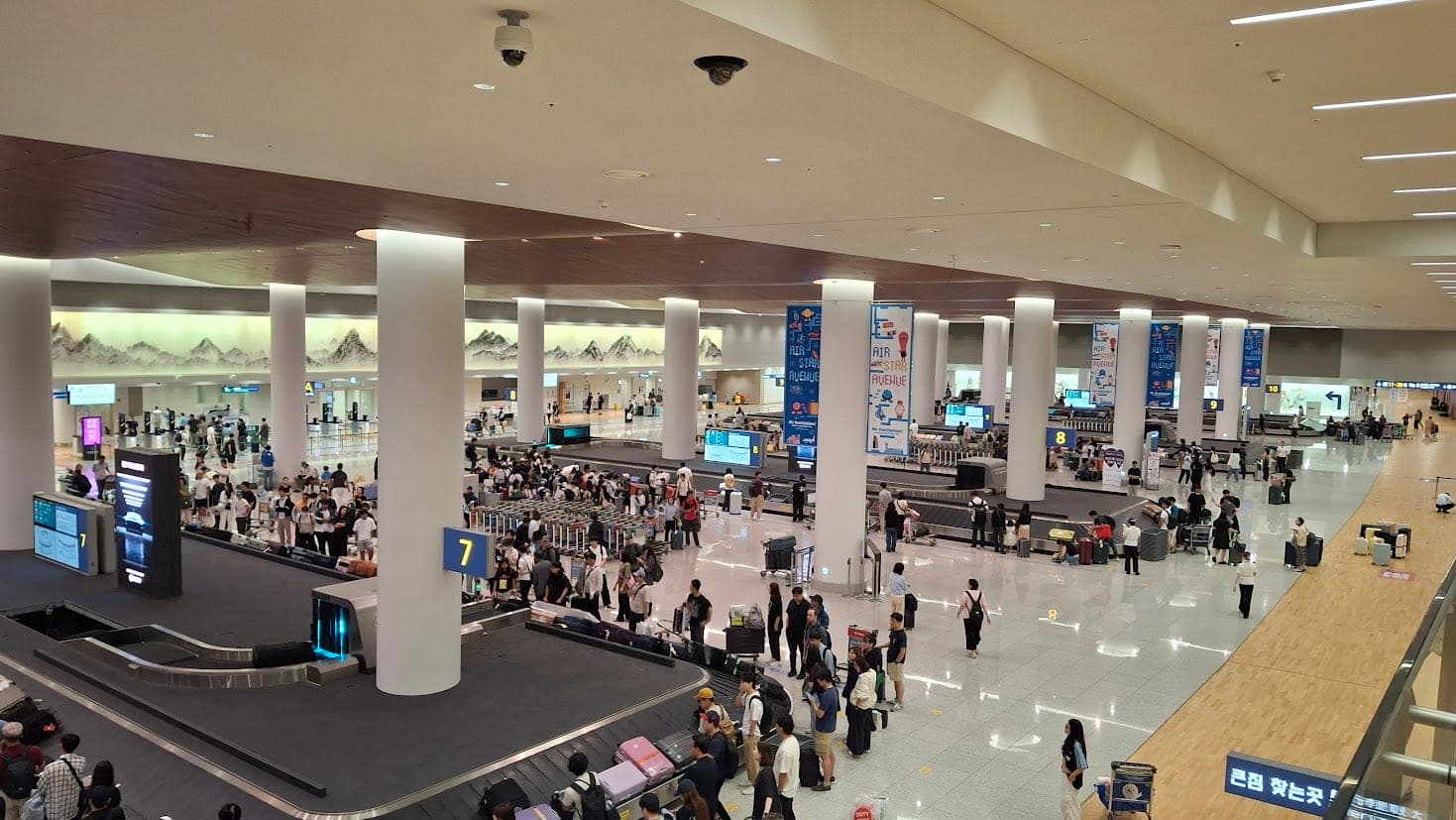
- Arrival hall, Incheon Airport Terminal 2: AirportTerminalGuy (CC BY 4.0)
Related guides
How to Pay in Korea: Cards, Cash and Transit
Foreign cards work in most Korean shops. They fail at market stalls, on Korean websites and at the subway gate, and each of those gaps has its own workaround.
Updated Sep 13, 2026
Seoul Subway Fares and Transfers: What a Ride Actually Costs
What a Seoul subway ride costs on a transit card, why so many guides still quote an old fare, and the transfer rule that decides what you actually pay in a day.
Updated Sep 13, 2026
DMZ Tours from Seoul: What You Can Actually Visit
The DMZ can only be visited on a guided tour, and the JSA at Panmunjom has been shut to the public since December 2023. What that means for what you book.
Updated Sep 12, 2026
Where to Stay in Seoul: Choosing an Area, Not a Hotel
Seoul is large and its sights are scattered, so the neighbourhood decides your trip more than the hotel does. What each main area is good and bad at.
Updated Sep 12, 2026